Posts

Showing posts with the label Fort Marion

Witness to History: Howling Wolf of the Southern Cheyenne, 1849-1927
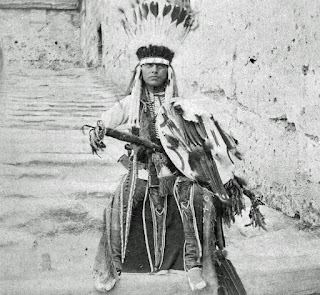
Image
On the morning of November 29, 1864, a 15-year-old Cheyenne warrior saw hell on earth unfold for his people.  He, along with his father Eagle Head, were in a camp headed by Cheyenne leader Black Kettle along Sand Creek in what is now Kiowa County, Colorado.  Black Kettle had been guaranteed safety by the local garrison commander and flew an American flag outside his lodge as a gesture of goodwill.  Most of the warriors had gone hunting for the day.  As John Chivington and the men of the 1st Regt. Colorado Volunteers rode down on them, Eagle Head and the other men scrambled to make a defense.  When it was over, 137 men, women and children, mostly non-combatants were dead.  The scene burned itself into Howling Wolf's memory for life. Howling Wolf, like many Cheyenne and Arapaho men, would spend the next decade in constant conflict with the Army and the Settlers encroaching on their land, killing buffalo and other game, and slowly eroding their way of l...

Places: Fort Marion/Castillo de San Marcos, St Augustine, Florida

Image
The Castillo de San Marcos (St. Mark's Castle), also known as Fort Marion, is a place of tears and death for many tribes who members and leaders have been imprisoned there.  The Apache Wars are beyond the scope of this blog, but we'll touch on the imprisonment of Apaches here as it relates to this Fort, one of the oldest fortified locations in the United States. St. Augustine is one of the oldest cities in the United States, being founded and continuously inhabited from 1565.  Construction on the Fort began in 1672, over a hundred years later, to combat raids on the town by English pirates.  Britain gained control of Florida briefly in 1763 and renamed the Castillo Fort St. Marks.  Its name was changed back to Castillo de San Marcos in 1783, when Britain returned Spain to Florida.  After 1819, when the Adams-Onis treaty turned Florida over to the United States, they christened the place Fort Marion, after Francis Marion, the Swamp Fox of Revolutionary War fame...

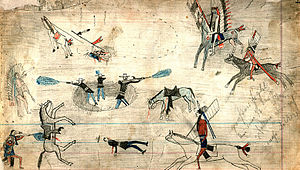
What Is: Ledger Art

Image
For centuries, Native people had decorated prepared hides, including robes, clothing, shields, tipis and other items with artistic touches.  Painting with quills or wooden stylus using dyes from plants were the earliest mediums.  Later, as animal populations became scarce and tribes were increasingly confined to reservations, new mediums presented themselves.  Instead of hides, there was paper and or fabrics available.  For paint, there were water colors, chalks, and ink.  From this difference in circumstances came a new type of art, known as ledger art. A ledger is a large book in which financial or other records are kept.  Traders, missionaries and military officers often had supplies of them on hand.  Native artists found the paper useful for a far more decorative and perhaps psychological purpose.  Painting on hides held many meanings.  Calendars kept track of tribal histories.  Personal paintings could commemorate success in war, ...