Posts

Painter: Karl Bodmer, 1809-1893

Image
Europeans have always been fascinated with the American west and with the Native peoples of the Plains.  Almost as soon as Lewis and Clark returned from their journey and published their notes and journals, seriously wealthy Europeans flocked to America, found guides and journeyed into the unknown, much like African safaris during the later 19th and early 20th centuries.  One such adventurer was German princeling Maximilian of Wied-Neuweid.  He toured the west in grand style, evening bringing an artist to chronicle it for him, Karl Bodmer. Karl Bodmer, 1809-1893, was born in Zurich, of Swiss-German parentage.  He early on showed an aptitude for art and became a painter, etcher, lithographer and engraver.  He traveled to the city of Koblenz in Germany and attracted the attention of Maximilian, who soon took Bodmer into his patronage.  Maximilian had journeyed to Brazil in 1815-1817, and was planning an adventure to America.  In his day, the Prince was...

Great Leader: Washakie of the Eastern Shoshone, c 1810-1900

Image
Native leaders had to be both proficient warriors and skilled diplomats, leading their people in warding off threats from other tribes and from the army, and making peace when it was advantageous to do so.  Washakie of the Eastern Shoshone, c 1810-1900 combined these skills so well that he maintained the respect of his people, and of White authorities.  As was typical of many Native warriors, his name changed throughout his life.  He was born to Lost Woman, a White Knife Shoshone woman and Crooked Leg, and Umatilla who had been rescued from slave traders by the Shoshone and raised among them.  Crooked Leg became a medicine man.  For the first few years of their life, their son was given a name meaning Smells Like Sugar.  After he was old enough to join the men on buffalo hunts and achieve his first kill, he changed his name to Shoots the Buffalo Running.  Washakie was the nearest English translation of his name.  Washakie would have seen his fir...

Places: Battlefield of the Rosebud, June 17, 1876

Image
Almost everyone knows what happened at the Battle of the Little Bighorn/Greasy Grass, June 26, 1876.  Units of the 7th Cavalry under Bvt. Maj. Gen./Col. George Armstrong Custer were overwhelmed by Sioux, Cheyenne and Arapahoe warriors and died where they stood, or fled.  However, days earlier, many of these same warriors had scored another significant victory, against a much larger army and an arguably more skilled opponent.  On June 17, 1876, Crazy Horse of the Oglala Lakota led an army of over 1,000 warriors, some sources estimate almost 1800, in an attack on Gen. George Crook's 950 soldiers supplemented by 175 Crow, 86 Shoshone and a scatter of 100 armed civilians.  Totals killed or wounded included, 13-36 killed and 65-100 wounded on the Sioux side and U.S. 14-28 killed, 43-46 wounded and, for the Crows and Shoshones, 1-5 and 1-8 killed respectively.  It wasn't the total wipeout that Little Bighorn was, but it did force Crook to await reinforcements before...

Places: Fort Marion/Castillo de San Marcos, St Augustine, Florida

Image
The Castillo de San Marcos (St. Mark's Castle), also known as Fort Marion, is a place of tears and death for many tribes who members and leaders have been imprisoned there.  The Apache Wars are beyond the scope of this blog, but we'll touch on the imprisonment of Apaches here as it relates to this Fort, one of the oldest fortified locations in the United States. St. Augustine is one of the oldest cities in the United States, being founded and continuously inhabited from 1565.  Construction on the Fort began in 1672, over a hundred years later, to combat raids on the town by English pirates.  Britain gained control of Florida briefly in 1763 and renamed the Castillo Fort St. Marks.  Its name was changed back to Castillo de San Marcos in 1783, when Britain returned Spain to Florida.  After 1819, when the Adams-Onis treaty turned Florida over to the United States, they christened the place Fort Marion, after Francis Marion, the Swamp Fox of Revolutionary War fame...

Myths and Misnomers: Scalp Knives, War Paint and War Bonnets

Image
The scalp knife is a staple of Western movies and dime novels, as well as many early non-fiction accounts describing Natives.  For example, observers of Osceola during his captivity at Fort Moultrie in 1838 noted that he was allowed to keep his "scalping knife" and had it clutched in his hand when he died.  True, many Native tribes did practice scalping, and Osceola did so on one particular occasion.  But they also engaged in other activities that would require a blade, combat or self defense, cleaning small game, making repairs to equipment or any other reasons a man might need a large utility knife while on the frontier or in the west.  In fact, both Settlers, Natives and even some military men carried large utility knives in sheaths or stuck in their belts or sashes.  Jim Bowie and his elder brother Rezin were famous for theirs.  No one would have thought of calling the Bowie knife or its variations a scalping knife, unless it happened to belon...

What Is: Ledger Art

Image
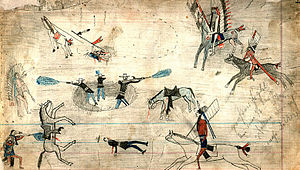
For centuries, Native people had decorated prepared hides, including robes, clothing, shields, tipis and other items with artistic touches.  Painting with quills or wooden stylus using dyes from plants were the earliest mediums.  Later, as animal populations became scarce and tribes were increasingly confined to reservations, new mediums presented themselves.  Instead of hides, there was paper and or fabrics available.  For paint, there were water colors, chalks, and ink.  From this difference in circumstances came a new type of art, known as ledger art. A ledger is a large book in which financial or other records are kept.  Traders, missionaries and military officers often had supplies of them on hand.  Native artists found the paper useful for a far more decorative and perhaps psychological purpose.  Painting on hides held many meanings.  Calendars kept track of tribal histories.  Personal paintings could commemorate success in war, ...

Great Leader: Naiche of the Chiricahua Apache, c 1857-1919

Image
Most Native tribes in North America didn't have a royal or noble class.  Even when leadership passed from father to son in patrilineal societies, or uncle to nephew in matrilineal ones, each man had to prove and keep proving his right to lead his people.  Naiche, c 1857-1919, the son of Cochise, made good his claim as the last hereditary leader of the Chiricahua, succeeding his father and his older brother Taza. Naiche in Apache means mischief maker.  He was the son of Cochise by his wife Dos-tes-y, meaning, Something Already Cooked in the Campfire, and born in the Chiricahua's home range of southern Arizona.  With Cochise as a father, Taza and Naiche would have received their warrior's training from the best, a man beloved by his people and feared by the Army and Settlers.  Naiche grew up to be tall and strikingly good-looking.  Army officer Britton Davis described him as being 6'1" and carrying himself as though he were a royal prince.  Naiche came...