Posts

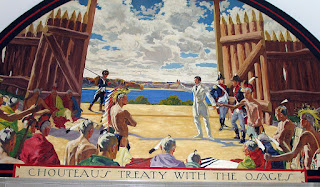
Treaty: Portage des Sioux, 1815

Image
Throughout the 18th century, North America was a pawn in the hands of European colonial powers, who frequently fought wars over how land an ocean away was to be divided up.  What we in America know as the French and Indian War (1755-1762), the American Revolution (1775-1783) and even the War of 1812 (1812-1814), were actually parts of wider conflicts regarding division of land.  When each war concluded, treaties were drawn up.  While they disposed of which European power got what chunks of real estate, the treaties rarely dealt with the needs or desires of the people most involved, the Natives who actually lived here. The Treaty of Ghent which ended the War of 1812 required the signatories, principally the United States, to "restore to such tribes or nations respectively all the possessions, rights and privileges which they may have enjoyed or being entitled to in 1811."  With such ambiguity, the treaty left the aforesaid rights, possessions and privileges open to ...

Places: Lewis and Clark Travois Trail, Pomeroy, Washington

Image
The wilderness that became the American west wasn't as trackless as people would think.  True, there were no established roads and European-American information about the area was superficial at best.  However, the Native people had long established trails for trading, hunting, warfare and other needs and used landmarks such as rocks, rivers and mountain passes as we would use modern road signs.  One of these surviving areas is a National Historic Place known as the Lewis and Clark Trail-Travois Road. When Lewis and Clark set out to return to Missouri and civilization in 1805-06, they would have to recross the Rocky Mountains.  To do so they would have to connect with one of the Native tribes on the western slopes.  The Nez Perce were as hospitable and willing to trade horses as the Shoshone had been.  Lewis and Clark used a portion of a path long known to the Nez Perce tribe.  Portions of the Lewis and Clark Trail run along an established Nez Perce ...

Places: Washita Battlefield Site, Cheyenne, Oklahoma

Image
To look at some battle sites today, it's hard to believe that scenes of unspeakable tragedy once took place there.  The site of the Battle of the Washita, near Cheyenne, Oklahoma, is now a grassland, with a museum, but on November 27, 1868, it was hell on earth where over 100 Cheyenne men, women and children perished in the dead of winter. In 1867, the Cheyenne and other major Plains tribes had agreed to a series of treaties known as the Medicine Lodge Treaties, which severely restricted their home and hunting ranges.  Hunting range was the most important, as all Natives knew that the rations supplied on reservations were never enough, and that disease and death followed starvation.  For this reason, many Cheyenne bands disavowed the treaties and continued to use their hunting ranges.  In 1868, the Army resolved on punitive strikes at winter encampments to force the Natives to go to the reservations.  On November 27, 1868, almost four years to the day after hi...

Great Leader: Black Kettle of the Southern Cheyenne, 1803-1868

Image
Some people's lives are one tragedy after another.  Black Kettle of the Southern Cheyenne was a capable leader and warrior who tried his best to deal with the realities of White incursion into his people's home and hunting range.  And he would face two of the most horrific incidents to happen in the west, the Sand Creek Massacre and the Battle of the Washita. Black Kettle was born in the Black Hills of South Dakota.  By birth, he was a member of a band of Northern Cheyenne, but he would marry into the Southern Cheyenne and achieve leadership among them.  He eventually became the leader of the Council of Forty Four, the governing body of the entire Cheyenne tribe, a testament to his skills as a leader and warrior.  In 1851, the Cheyenne had signed the Treaty of Fort Laramie, which set the boundaries for their land and guaranteed that the U.S. would prevent trespassers.  The Settlers kept coming and conflicts between Cheyenne war and hunting parties an...

Opposition: the Texas Rangers

Image
To most people today, the name Texas Rangers conjures up images of law enforcement and indeed today's Texas Ranger Division is made up of sworn peace officers who do exactly that.  However, they began life in Texas as a paramilitary unit and their first enemies were Natives, principally the Cheyenne.  This post covers the early period of the Rangers.  It would be impossible to do their entire history justice here. Rangers and ranging are as old as the frontier in America.  Some of the first ranger-type companies were gathered in Plymouth and other Massachusetts towns in response to the unrest along the frontier in the east.  Beginning in 1823, Stephen F. Austin appointed ten men to protect the settlers who arrived in Texas following Mexico's independence from Spain.  The Rangers were formally constituted in 1835 and comprised over 300 men.  After Texas won independence from Mexico in 1836, Mirabeau B. Lamar, the second President of the Republic of Te...

Treaty: Fort Clark, 1808

Image
With the lands of the Louisiana Purchas bought (1803) and explored (1804-1806), it was time to decide how to deal with the various tribes who inhabited them.  Due to their experience with many of the tribes in the region, both William Clark and Meriwether Lewis were among the first Indian Agents appointed west of the Mississippi.  It was Meriwether Lewis who, working through French trader Pierre Chouteau, conducted the first treaty parleys with the Osage.  Pierre Chouteau had taken a delegation of Osage leaders to meet with President Jefferson in Washington in 1804, while Lewis and Clark were still gearing up for their expedition.  Jefferson recognized that Individual tribes would be subject to exploitation by the burgeoning fur trade business and moved to take control of the situation.  He wanted to establish a trading post to conduct trade with the Osage.  In 1808, Meriwether Lewis led a party of soldiers to what became Fort Osage and later Fort Clark n...

People of the Middle Waters: the Osage

Image
One of the more formidable tribes with whom early explorers had to contend in what is now Missouri, Arkansas, Kansas and Oklahoma were the Osage.  The Osage are a Midwestern tribe, a Dhegihan-Siouan-speaking people.  Their name in English comes from a French word meaning war-like.  Their name for themselves refers to People of the Middle Waters.  Their home range extended between the Missouri and Red Rivers, the Ozarks to the Wichita Mountains.  They were both buffalo hunters and did practice agriculture. Like many tribes who later migrated to the Plains, the Osage, along with the Kansa, Quapaw, Omaha and Ponca, who also speak Dhegihan languages, came from the lower Ohio Valley.  Pressure from the Iroquois caused their early ancestors to migrate during the 17th century Beaver Wars, at which point the various Dhegihan-speaking people spread out and split up.  They were encountered in their present homelands by the French in 1673 near the Omaha River i...